
Abstract
New species have been introduced into new habitats throughout history. While this might result in them being successfully established into an ecosystem without any side-effects, it can lead to various adverse effects on the ecosystem. When a non-native species establishes itself successfully in a forest, either positive or negative effects might follow. However, since the government is never sure of the exact impact this introduction might have on the ecosystem, a certain level of control over the species that are introduced in a habitat is required. Moreover, due to the adverse effects a non-native species or pathogen could have in a habitat, their establishment should be prevented or controlled. One such species is the Hemlock Woolly Adelgid that is currently threatening hemlock trees in the US and Canada, alongside other species that depend on these trees. Their continued spread across the country’s hemlock forests serves as a warning to forest managers to develop relevant plans on how this situation can be managed and, in some cases, mitigated. This can be done in either four phases of a species’ establishment—absent, localized, spreading, and pervasive. This paper presents policies on how this can be done for each of the four phases of the spread of non-native forest insects and pathogens; absent, localized, spreading, and pervasive. Causal loop diagrams (CLD) have been used to demonstrate the interdependencies between forest ecosystem dynamics as the non-native species spread and the potential polices authorities can implement as responses.
keywords: non-native species, pathogens, absent, localized, spreading, pervasive
Introduction
Throughout the world’s history, species have been continuously introduced and established in new habitats (Perrings et al., 2005). The introduction of these new species in habitats often causes extensive and cascading changes in the native biodiversity and functioning of the ecosystem (Perrings et al., 2005). Despite this interchange of species being commonplace in the early stages of the planet’s history, today’s trends have caused significant increases in the number of new species being introduced to other habitats. This is often referred to as hitchhiking of species.
One such species is the Hemlock Woolly Adelgid (HWA), which is currently threatening hemlock trees in the US and Canada along with other species that depend on these trees (Emilson & Stastny, 2019). Once they arrive in a new habitat, it is usually up to the new species to adapt and establish themselves in the new ecosystem. However, since this is dependent on several factors, hitchhiking species are often thought to fail to establish themselves successfully in the new habitats (Emilson & Stastny, 2019). For instance, these species need to be in a life stage that is conducive for surviving not only the journey but able to quickly adapt to the new conditions of the habitat they arrive in (US Forest Service, n.d.). However, although there are various challenges to a species adapting and establishing themselves in a new habitat, some manage to accomplish this feat due to a number of factors, ultimately causing extensive ecological impacts on the habitat. This is especially true in situations where a non-native forest species (NNFS) is introduced into a habitat where there are no immediate enemies and resources are abundant, for which there is no competition with other species.
There are hundreds of species of non-native insects and pathogens in forests that, due to lack of natural enemies and other factors, manage to establish themselves successfully and cause significant levels of damage to the natural and urban forests (Branco et al., 2019; US Forest Service, n.d.). A good example of such a species that requires immediate attention from the government and other related institutions is the Hemlock Woolly Adelgid (HWA). This NNFS has thus far decimated hemlock stands across much of the eastern US and Canada. The Hemlock Woolly Adelgid is an invasive, aphid-like insect native in Asia, specifically Japan. As a result of hitchhiking, Hemlock Woolly Adelgid was introduced to the country’s hemlock, which has caused devastating effects on the ecosystem and the economy. Hemlock is one of the sources of revenue, especially in the pulp. Its year-round shading canopy contributes to lower air and water temperatures. As such, it shelters forest’s understories from snow and harsh weather and also helps in the maintenance of consistent hydrology. Also, some bird species such as the black-throated green warbler, Blackburnian warbler, and the Acadian flycatcher depend on the dense canopy these trees form. With these advantages, species such as brook trout, deer, and moose find a conducive environment. However, due to Hemlock Woolly Adelgid’s pervasiveness in these habitats, different species that depend on these trees are now affected.
To this end, the government and other organizations have been engaged in different prevention and control initiatives aimed at controlling or preventing the introduction of non-native insects or pathogens to forests. However, despite these initiatives, these species continue to be a persistent and significant problem that currently plagues the country. This has often been attributed to the increased global trade volumes that help the species through provision of means of transport globally. According to Aukema et al. (2011), the efforts of reducing the impact of these species and dealing with their side-effects costs the government at least $2.5 billion annually.
Moreover, according to Kovacs et al. (2011), the Emerald Ash Borer (just one particularly problematic species) will cost the government between %5.1 – 12.5 Billion over ten years (Tobin, 2015). This is arguably one of the global trade’s most expensive disadvantages. As the world becomes more connected and globalization takes its toll, human’s biotechnical, ecological, and socio-political factors are likely to mitigate or exacerbate the spread of these species. In this case, the government and other involved institutions need to take control of the situation and devise methods with which the spread of these species can either be controlled or mitigated (Nisbet et al., 2015). This paper aims to present policies on how this can be done for each of the four phases of the spread of non-native forest insects and pathogens—absent, localized, spreading, and pervasive. Causal loop diagrams (CLD) will be used to demonstrate the interdependencies between forest ecosystem dynamics as the NNFS spreads and the potential polices authorities can implement as responses. The paper will primarily focus on controlling the spread and establishment of the Hemlock Woolly Adelgid species.
Absent
This phase is so named as it is the phase before the NNFS has established itself (when it is absent) (Tobin, 2015). Policies implemented during this phase are arguably the most effective mechanisms as they help in avoiding the environment and economic damage caused by the NNFS (Nisbet et al., 2015). The policies in question are majorly centered on prevention, detection, and early response. A majority of the policies implemented try to prevent the establishment of the NNFS; therefore, mitigating any side effects that they might cause to the environment. One method often employed by the government is expanding the use of post-entry quarantines and enhancing transmission control efficacy (Tobin, 2015). An example of a transmission control is monitoring controls on the water spray of imported timber. These and other efforts are aimed at helping the government control the initial establishment of the species.
Since their spread is linked to global trade, one policy that the government has adopted is incorporating effective protection and detection mechanisms within the international trade agreements. Some of the policies adopted include the Sanitary and Phytosanitary Measures (SPS), which is similar to the “polluter pays” principle in matters of pollution (Aukema et al., 2005). Here, the exporting country is expected to apportion funds and implement measures that prevent activities that can increase the risk of NNFS hitchhiking (Tobin, 2015). Another policy is by importing countries implementing stringent measures such as inspections by customs and heating or chemically treating materials that are at high risk of introducing these species into the environment. Another ingenious method observed is countries monitoring the long term and short-term risks of NNFS by establishing sentinel tree programs in exporting countries (Tobin, 2015). Currently, the US has similar programs studying the effects of Hemlock Woolly Adelgid in countries such as Japan and others in Asia (Emilson & Stastny, 2019). This allows them to monitor how these pests affect the botanical gardens and therefore help countries prepare for the potential side effects they might have if they successfully establish themselves. The CLD diagram below showcases these and other policies the government can implement to help achieve this and how they relate to the ecosystem dynamics.
Although effective, some of these methods are very expensive and, to some extent, not viable technologically. For instance, despite its effectiveness, sentinel tree programs are expensive and take time for observations to be made (Nisbet et al., 2015). As such, this might not be viable in some situations. On the other hand, making changes such as imposing tariffs on live plants and other problematic goods and investing in the microwave heating and other methods might not be as viable as they might significantly affect trade (Nisbet et al., 2015). Countries such as Canada have considered tariffs as a result of the devastating effects of Hemlock Woolly Adelgid on Eastern Hemlock in the country (Emilson & Stastny, 2019). Here, the government can opt for methods that do not necessarily affect trade, but rather determine ways of implementing safety measures without necessarily affecting the flow of goods. This will create a win-win situation between the two issues and, in some cases, foster compromises from both sides that might enhance the fight against NNFS.
Localized
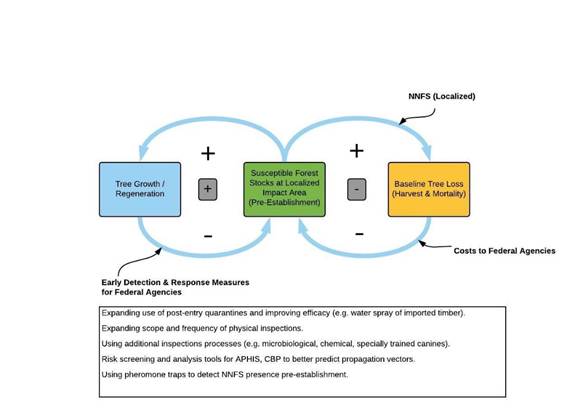
Due to the limitations the policies outlined above may have, factors such as personal mobility and global trade continue to create opportunities for NNFS to enter the US (Aukema et al., 2005). As such, standards that would act as the first line of defense if these species manage to enter the country are required. These policies’ main aim is to prevent the release and spread of the NNFS from their point of entry (when they are localized) (Olivia et al., 2016). Being the first line of defense, this phase often takes the largest cost burden on institutions trying to combat the NNFS establishment. These institutions have to conduct research and determine methods of limiting the spread of these NNFS and pathogens without necessarily affecting other aspects such as trade and the economy.
One of the most common policies implemented is delaying imports that could potentially harbor the NNFS or pathogens. This often takes the form of simple quarantining, where the products are held for a period beyond the NNFS or pathogen’s natural life cycle (Lovett et al., 2016). Despite its simplicity, this method is rarely effective when weighed against its costs as it affects the economic viability of trade and is not effective on all NNFS or pathogens. However, this method is often effective when trying to control boring insects using methods such as storing imported timber or wood from susceptible forests (Lovett et al., 2016). Another method explored by experts is the use of sophisticated spatial and multi-variate modeling. This method informs possible transmission vectors and can allow changes in how a specific product is handled to be made based on the results it offers (Olivia et al., 2016). The method is cost-effective and can significantly increase the effectiveness of involved parties in responding to NNFS and pathogens. Coupled with modern technological trends such as Artificial Intelligence and machine learning, the federal government can create better models and understand the behavior of NNFS better. As a result, they can prevent their establishment and spread.
Implementing some of these methods is often hard as it involves intensive research to determine the NNFS and pathogens’ possible vectors or modes of transmission (Tobin, 2015). This often takes time and significantly reduces both the economic viability of the methods. In matters technology, those involved often have to use methods and resources currently available to them and this does not necessarily state of the art technology that would enable more effective implementation of control measures (Olivia et al., 2016). This significantly contributes to failure at this stage, despite the immense costs often associated with the procurement of technology and research. Therefore, despite its advantages, these policies are costly, both economically and technologically, and without the necessary knowhow, one cannot effectively implement and use them. As such, this significantly reduces its viability. The CLD diagram below shows the policy and response options for controlling or mitigating the establishment of Hemlock Woolly Adelgid during the localized phase.
Spreading
Once the NNFS or pathogen becomes established and starts spreading, much of the policies involved typically involve slowing down its spread and trying to build resiliency within the population affected (Tobin, 2015). By all accounts, this should be avoided. When the NNFS or pathogen is localized or is still absent, the government and other institutions still have a lot of options that they can implement to maintain the status quo (Aukema et al., 2005). However, once the spreading phase has started, conditions change drastically, and to prevent further damage, immediate action is often required. Reacting as early as possible is often recommended as it can help limit the spread of the NNFS or pathogen.
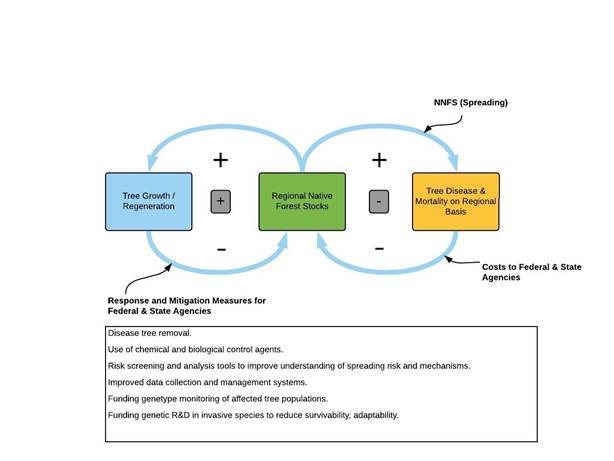
Some of the common measures implemented by the government and other institutions include the use of biological and chemical agents to try and mitigate the spread of the new species (Aukema et al., 2005; Payette et al., 2015). For instance, in the case of the Hemlock Woolly Adelgid, expanding detection surveys, incursion, and isolation is often employed to limit spread and try to eradicate the NNFS. Additionally, the government can try to isolate and propagate the tree genotypes that show more resilience to the NNFS or pathogen, therefore, ensuring that despite the presence of the species in the habitat, their effects will be significantly reduced (Payette, Drouin, & Koubaa, 2015). The US has been engaged in isolating and removing the hemlock that is already infected to try and prevent further spread across forests (Emilson & Stastny, 2019). This helps in damage control. In other instances, the government can also consider genetically modifying the NNFS or pathogen. This is done to reduce its ability to reproduce or survive. Alternatively, the government can also encourage or introduce the NNFS’ enemies or taxa that would actively predate on them and will not have a significant impact on the habitat afterward (Tobin, 2015). If successful, these efforts would result in a reduction of the NNFS’ populations and mitigate its spread to other forests.
Despite the ability of the government to still have some form of control over the situation, the government should not let the Hemlock Woolly Adelgid reach this phase. As noted from the policies and measures implemented, as the Hemlock Woolly Adelgid spreads, the control measures become more complex and expensive. The implication is that depending on the situation, some of these measures would not be viable. On the other hand, some of these methods, such as genetic manipulation or modifying some of the conditions in the ecosystem by introducing other taxa, can have unintended harmful consequences in the habitat (Payette et al., 2015). As a result of the costly nature of these methods, experts often recommend turning to other methods such as active forest management to leverage good silviculture practices and is deemed less risky (Payette et al., 2015). However, it is important to note that all these methods have their costs and can result in disastrous side effects. The CLD diagram below shows some of the policy and response options for controlling or mitigating the establishment of Hemlock Woolly Adelgid during the spreading phase.
Pervasive
At this phase, the Hemlock Woolly Adelgid or NNFS is already well established and has spread over considerable tracts of forest cover (Oliva et al., 2016). Most of the mitigation policies that can be adopted at this point are far expensive and harder to implement than all the other prior phases. Also, it is worth noting that even though other phases often involved the government in trying to mitigate entry, spread, and establishment, this phase involves the municipality or individual (landowner or property owner) affected by the menace (Branco et al., 2019; Oliva et al., 2016). With an already well-established NNFS or pathogen, the side effects it might have had on the environment have already been observed, and if negative, things are often getting worse at this point.
In some cases, these NNFS often cause the loss of native species and create changes that reverberate throughout the ecosystem. For instance, in forests, they cause changes such as the loss of biodiversity, lead to the emergence of competition species, may adversely affect the soil’s biota, and can disrupt nutrient cycling and riparian systems (Branco et al., 2019; Tobin, 2015). While various well-managed forest systems have been known to effectively manage and mitigate the damage these NNFS cause to the ecosystem and the economy in the area/state, often, many fail to take control of the situation. For Hemlock Woolly Adelgid, the government is currently considering the introduction of complex predators that will collectively feed on the different life stages of the Hemlock Woolly Adelgid all year round to help with control and limit their spread (Emilson & Stastny, 2019). However, this might have devastating results on the ecosystem if thorough research is not conducted to analyze the potential effects of this and how the government can limit the side-effects.
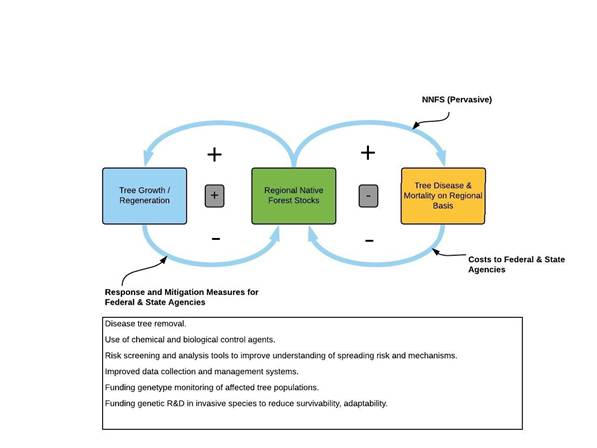
The policies and measures implemented in this phase generally depend on the specific NNFS or pathogen plaguing the ecosystem. For instance, in cases involving the Emerald Ash Borer, effective management of canopy gaps and leaf litter from replacement species in riparian systems has been cited as an effective means of reducing the impact of the species on the ecosystem as they cause the loss of trees (Tobin, 2015). Biological and chemical control agents can also be used in addition to diseased tree removal. This is often the preferred method when it comes to the Hemlock Woolly Adelgid as its rate of spread is faster. Additionally, due to the damage control nature of all aspects within the pervasive phase, institutions and individuals often turn to this option. Depending on the individual or institution dealing with the issue, other measures might include risk screening, collecting, and analyzing data that can be used to understand the species better and how to control them.
The government has also been noted to help out by funding research on how these species can be combated by reducing their adaptability and survivability (Branco et al., 2019). For instance, the government currently heavily funds research surrounding the control of Hemlock Woolly Adelgid due to the effects it has had on the country’s economy and hemlock populations (Emilson & Stastny, 2019). In this regard, depending on the individual or institution affected or involved in tackling the issue, economic or technological viability might vary. For instance, a landowner might not have access to the right technology, while a municipality addressing the issue in a forest might not necessarily have the resources to fund genetic research. In such a case, government support plays a vital role in enabling the control of these species. The CLD diagram below shows some of the policy and response options for controlling or mitigating the establishment of Hemlock Woolly Adelgid during the pervasive phase. The policies are relatively similar to those of the spreading phase. However, they are more intensive as the effects of the NNFS are often already observable; hence, implying that the situation is dire.
Conclusion
Given the US collective demand for products and goods sourced from other countries, invasions by NNFS and pathogens is likely to continue. Unfortunately, trying to limit this invasion often involves trying to find a middle-ground between enhancing trade and economic growth and ensuring that all insects or pathogens non-native to the country are dead or their likelihood of establishment is zero to none. However, due to insufficient regulation and the fact that the country is often driven by its economic interests, it is increasingly hard for the introduction and establishment of NNFS to be prevented. It is evident that for some species such as the Hemlock Woolly Adelgid, the situation is already in the pervasive phase for some of the forests. As a result, the government can adopt strategies that limit their spread to other areas. However, despite methods being recommended to prevent and mitigate the establishment of these species, it is evident that technology and economic constraints continue to prevent their implementation. It is, therefore, imperative for action to be taken to try and reduce the likelihood of NNFS and pathogens hitchhiking from other countries. If done correctly and effectively, the government can significantly reduce the costs incurred in later phases if a species manages to establish itself. However, if this cannot be done, the government should, at the very least, invest in active forest management practices as they have been noted as some of the most effective methods of enhancing the resilience of forests and enabling their restoration at a far cheaper cost than other methods.
References
Aukema, J. E., Leung, B., Kovacs, K., Chivers, C., Britton, K. O., Englin, J., Frankel, S. J., Haight, R. G., Holmes, T. P., Liebhold, A. M., McCullough, D. G., & Von Holle, B. (2011). Economic impacts of non-native forest insects in the Continental United States. PLoS ONE, 6(9), e24587. https://doi.org/10.1371/journal.pone.0024587
Branco, M., Nunes, P., Roques, A., Fernandes, M. R., Orazio, C., & Jactel, H. (2019). Urban trees facilitate the establishment of non-native forest insects. NeoBiota, 52, 25-46. https://doi.org/10.3897/neobiota.52.36358
Emilson, C. E., & Stastny, M. (2019). A decision framework for hemlock woolly adelgid management: Review of the most suitable strategies and tactics for eastern Canada. Forest Ecology and Management, 444, 327-343. https://doi.org/10.1016/j.foreco.2019.04.056
Kovacs, K. F., Mercader, R. J., Haight, R. G., Siegert, N. W., McCullough, D. G., & Liebhold, A. M. (2011). The influence of satellite populations of emerald ash borer on projected economic costs in U.S. communities, 2010–2020. Journal of Environmental Management, 92(9), 2170-2181. https://doi.org/10.1016/j.jenvman.2011.03.043
Lovett, G. M., Weiss, M., Liebhold, A. M., Holmes, T. P., Leung, B., Lambert, K. F., Orwig, D. A., Campbell, F. T., Rosenthal, J., McCullough, D. G., Wildova, R., Ayres, M. P., Canham, C. D., Foster, D. R., LaDeau, S. L., & Weldy, T. (2016). Nonnative forest insects and pathogens in the United States: Impacts and policy options. Ecological Applications, 26(5), 1437-1455. https://doi.org/10.1890/15-1176
Nisbet, D., Kreutzweiser, D., Sibley, P., & Scarr, T. (2015). Ecological risks posed by emerald ash borer to riparian forest habitats: A review and problem formulation with management implications. Forest Ecology and Management, 358, 165-173. https://doi.org/10.1016/j.foreco.2015.08.030
Oliva, J., Castaño, C., Baulenas, E., Domínguez, G., González-Olabarria, J., & Oliach, D. (2016). The impact of the socioeconomic environment on the implementation of control measures against an invasive forest pathogen. Forest Ecology and Management, 380, 118-127. https://doi.org/10.1016/j.foreco.2016.08.034
Payette, M., Work, T. T., Drouin, P., & Koubaa, A. (2015). Efficacy of microwave irradiation for phytosanitation of wood packing materials. Industrial Crops and Products, 69, 187-196. https://doi.org/10.1016/j.indcrop.2015.01.030
Perrings, C., Dehnen-Schmutz, K., Touza, J., & Williamson, M. (2005). How to manage biological invasions under globalization. Trends in Ecology & Evolution, 20(5), 212-215. https://doi.org/10.1016/j.tree.2005.02.011
Tobin, P. C. (2015). Ecological consequences of pathogen and insect invasions. Current Forestry Reports, 1(1), 25-32. https://doi.org/10.1007/s40725-015-0008-6
US Forest Service. (n.d.). Invasive species. https://www.fs.fed.us/foresthealth/protecting-forest/invasive-species/
Do you need help with this assignment or any other? We got you! Place your order and leave the rest to our experts.